
Behaviour and investing series September 2026
Markets can influence investor behaviour in different ways. Last quarter, we explored herd behaviour and the tendency to follow the crowd during periods of rising optimism. Another common bias can emerge when recent market experiences exert too much influence over expectations about the future.
Concept #3: Recency bias — why recent winners can be hard to resist
Investors naturally look to the past when making decisions about the future. While recent market performance can provide useful information, investors sometimes give it too much weight. This tendency, known as recency bias, occurs when investors assume recent trends will continue, even though market leadership often changes over time.
Recency bias can influence investment decisions in several ways. Following a period of strong performance, investors may become increasingly attracted to the best-performing areas of the market. Conversely, areas with weaker returns may be overlooked or viewed less favourably, even if they offer attractive long-term opportunities.
The challenge is that market leadership rarely remains constant. Different asset classes, regions and sectors tend to perform well at different stages of the economic and market cycle. What performed best over the past few years is not necessarily what will perform best over the next few years. The chart below highlights this reality. Over the past decade, leadership has rotated among the different asset classes. While some asset classes enjoyed periods of strong performance, none consistently ranked first year after year.
The challenge is that market leadership rarely remains constant. Different asset classes, regions and sectors tend to perform well at different stages of the economic and market cycle. What performed best over the past few years is not necessarily what will perform best over the next few years. The chart below highlights this reality. Over the past decade, leadership has rotated among the different asset classes. While some asset classes enjoyed periods of strong performance, none consistently ranked first year after year.
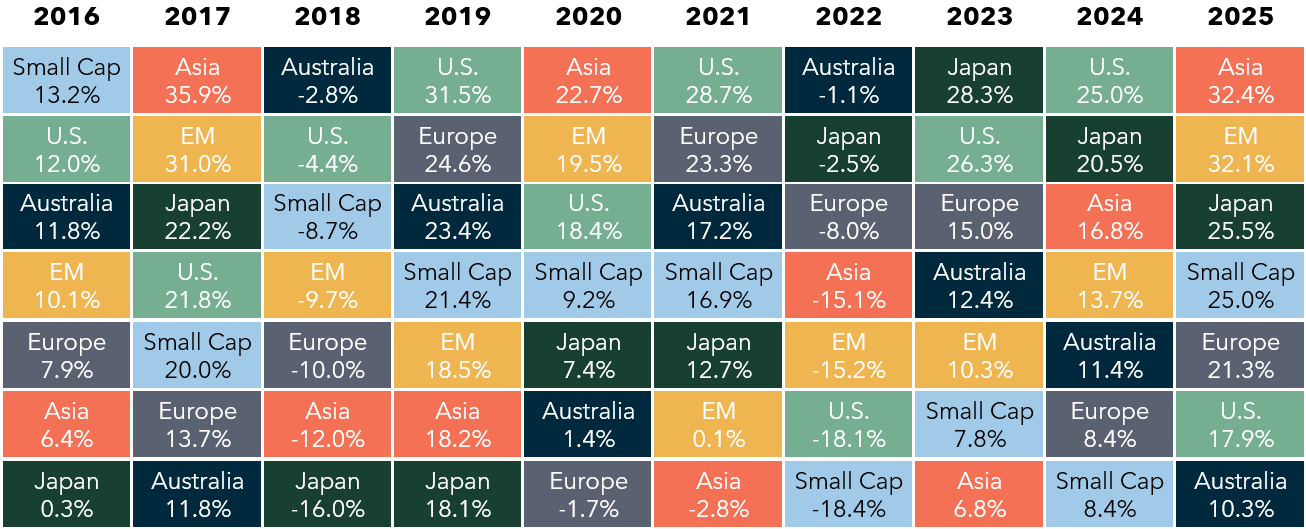
Source: FactSet, MSCI, Standard & Poor’s, TOPIX, JPMorgan Asset Management. Based on local currency total returns. Australia: ASX 200 Index; Small Cap: S&P ASX Small Ordinaries; Asia: MSCI AC Asia ex Japan; EM: MSCI EM Index; Europe: MSCI Europe Index; Japan: TOPIX first section; U.S.: S&P 500 Index.
This uncertainty is why diversification remains a core investment principle. A diversified portfolio does not attempt to predict which market will outperform next. Instead, it seeks exposure to a range of opportunities, reducing reliance on any single investment outcome.
Understanding recency bias can help investors avoid placing too much weight on recent performance. While strong returns can be encouraging, maintaining a diversified approach and focusing on long-term objectives can help ensure investment decisions reflect a broader perspective rather than the most recent market trends.
Ironbark Advice is the sponsor of the Partners Portfolios. Ironbark Advice is comprised of the following wholly owned entities of Ironbark: Advice First Pty Ltd, Advisory Group Pty Ltd, ARTT Group Pty Ltd, Brisbane Financial Services Pty Ltd, Elevate Financial Solutions Pty Ltd, Emohruo Financial Services Pty Ltd, Invest Blue Armidale Pty Ltd, Invest Blue Brisbane Pty Ltd, Invest Blue Coffs Harbour Pty Ltd, Invest Blue Direct Pty Ltd, Invest Blue Gladstone Pty Ltd, Ogilvie Financial Services Pty Ltd, TDT (Tas) Pty Ltd, The Bravien Group Pty Ltd, Vintage Wealth Pty Ltd and Wainscott Financial Planning & Advice Pty Ltd, trading as Ironbark Advice are authorised representatives and credit representatives of Akumin Financial Planning Pty Limited, Australian Financial Services Licence and Australian Credit Licence No. 232706. Countrywide Advice Pty Ltd and GrowUp Financial Pty Ltd trading as Ironbark Advice are authorised representatives and credit representatives of Charter Financial Planning Limited, Australian Financial Services Licence and Australian Credit Licence No. 234665. GR & LC Thompson Pty Ltd trading as Ironbark Advice, is an authorised representative and credit representative of Hillross Financial Services Limited, Australian Financial Services Licence and Australian Credit Licence No. 232705. LFC Advice Pty Ltd (ABN 19 647 509 466) trading as Ironbark Advice, is a Corporate Authorised Representative of LFC Group Pty Ltd (ABN 35 644 576 965), AFSL 526600.