
Behaviour and investing series March 2026
Markets continue to experience periods of uncertainty, with fluctuations that can test investor confidence and raise questions about whether to stay invested. While much of the focus during these times is on what markets are doing, an equally important consideration is how we respond to them. This marks the start of a new series exploring investor behaviour and its role in long-term outcomes.
Concept #1: Loss aversion — why staying invested is so difficult
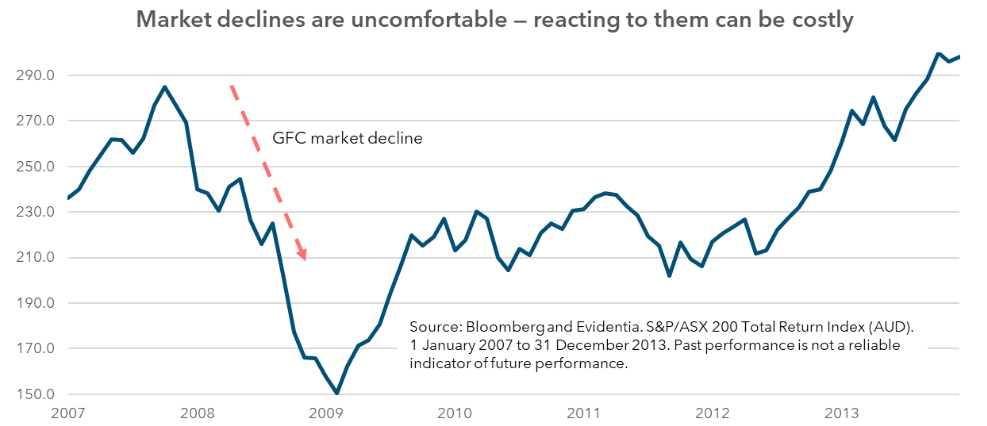
One of the most powerful influences on investor decision-making is loss aversion. In simple terms, losses tend to feel more significant than gains of a similar size. A decline in portfolio value is often experienced more intensely than the satisfaction of an equivalent increase, even when both are a normal part of investing.
This helps explain why periods of market weakness can feel particularly uncomfortable. When markets fall, the instinct to reduce risk or move to cash can be strong, even for investors with long-term objectives. While understandable, acting on this instinct can lock in losses and reduce the ability to participate in any subsequent recovery.
Over time, these experiences can shape broader behaviour. Investors may become more cautious, holding higher levels of cash or delaying investment decisions altogether. While this can feel like a way to avoid further losses, it can also reduce exposure to the long-term growth that markets have historically delivered.
Importantly, this behaviour is not a reflection of poor judgement, but a natural human response. Investors tend to place greater weight on potential losses than gains when making decisions under uncertainty, which can lead to choices that prioritise short-term comfort over long-term outcomes. Maintaining discipline through these periods is often one of the most valuable contributors to long-term investment success. Rather than reacting to short-term movements, a considered approach focuses on staying aligned with long-term objectives and maintaining appropriate market exposure.
In practice, this often means the greatest risk to long-term returns is not market volatility itself, but the decisions made in response to it. Understanding how loss aversion influences behaviour can help reframe periods of market volatility, not simply as a source of risk, but as part of the investment journey, where consistency and discipline play a key role in achieving long-term goals.
Ironbark Advice is the sponsor of the Partners Portfolios. Ironbark Advice is comprised of the following wholly owned entities of Ironbark: Advice First Pty Ltd, Advisory Group Pty Ltd, ARTT Group Pty Ltd, Brisbane Financial Services Pty Ltd, Elevate Financial Solutions Pty Ltd, Emohruo Financial Services Pty Ltd, Invest Blue Armidale Pty Ltd, Invest Blue Brisbane Pty Ltd, Invest Blue Coffs Harbour Pty Ltd, Invest Blue Direct Pty Ltd, Invest Blue Gladstone Pty Ltd, Ogilvie Financial Services Pty Ltd, TDT (Tas) Pty Ltd, The Bravien Group Pty Ltd, Vintage Wealth Pty Ltd and Wainscott Financial Planning & Advice Pty Ltd, trading as Ironbark Advice are authorised representatives and credit representatives of Akumin Financial Planning Pty Limited, Australian Financial Services Licence and Australian Credit Licence No. 232706. Countrywide Advice Pty Ltd and GrowUp Financial Pty Ltd trading as Ironbark Advice are authorised representatives and credit representatives of Charter Financial Planning Limited, Australian Financial Services Licence and Australian Credit Licence No. 234665. GR & LC Thompson Pty Ltd trading as Ironbark Advice, is an authorised representative and credit representative of Hillross Financial Services Limited, Australian Financial Services Licence and Australian Credit Licence No. 232705. LFC Advice Pty Ltd (ABN 19 647 509 466) trading as Ironbark Advice, is a Corporate Authorised Representative of LFC Group Pty Ltd (ABN 35 644 576 965), AFSL 526600.